

The predator from within...
If you have a young caterpillar that repeatedly falls off its food-plant despite being awake and able to move, and seems to lack coordination and shows no interest in eating, it may have been infected by a parasitoid wasp.
The young caterpillar shown below the video played host to the larva of a type of parasitoid wasp (perhaps a species of Apanteles), which devours a substantial portion of the caterpillar's innards. The larva then emerges from the caterpillar's body and immediately starts spinning itself a cocoon using its own silk. Within a week or two, a tiny wasp (pic below) will hatch from the cocoon. These wasps had been incorrectly identified on this page as Trichogramma wasps, but the latter are far smaller and have shorter antennae and stubbier wings, and do their damage to butterfly eggs rather than to caterpillars. [thanks to Jean in Portland].

The caterpillar shown above is dead, or nearly so. Although the wasp larva, while growing inside the caterpillar, appears to spare the muscles and nervous system of the caterpillar so that the caterpillar will be able to hold onto the twig or leaf and also retain its reflex to move its head away from contact with another caterpillar. The caterpillar will look dead soon after the wasp larva emerges, but may well respond to gentle nudging for 2 or more days.

Above is another seemingly dead (but probably not) caterpillar and its wasp cocoon. Notice that the surface of the fennel frond is well-silked by the caterpillar.
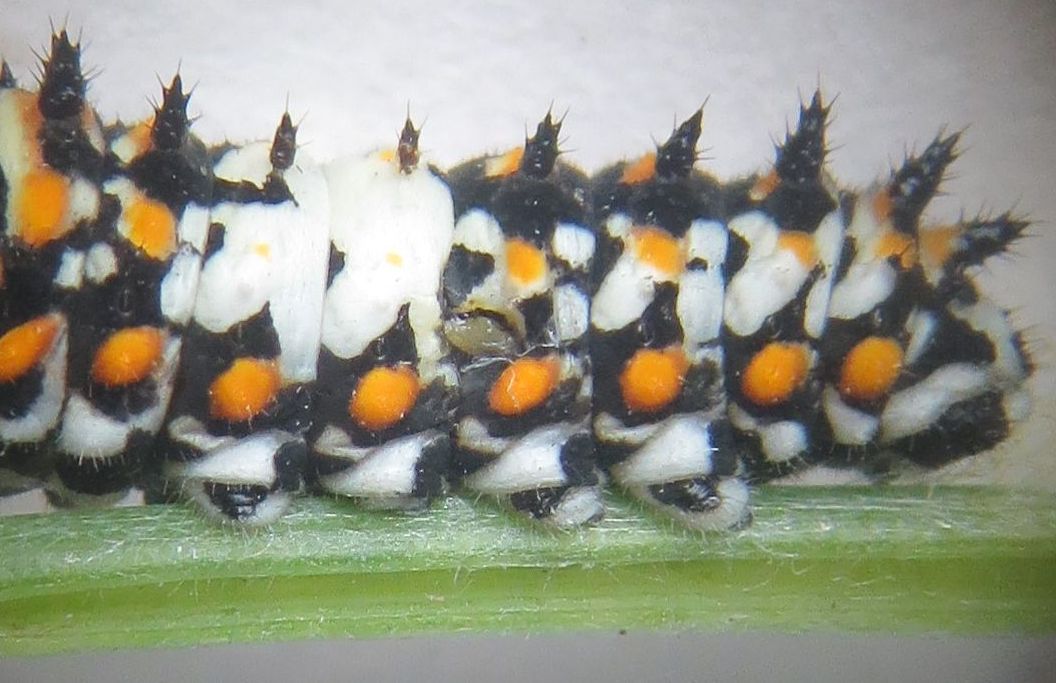
Below is the rear 2/3 of what appears to a 4th instar caterpillar from which a wasp larva has emerged. It's rare to see a wasp larva emerge from a caterpillar beyond the 3rd instar. The hole through which it emerged is plugged by tissue of some sort which appears to be slightly extruded through the hole. It is claimed that a wasp larva in a caterpillar consumes practically all of the internal tissues, including the intestinal tract. The caterpillar was still alive and responding to gentle nudges.
Below is a picture taken
through the low-power lens (described in tools)
of 2 wasps and the cocoons from which they hatched. That's a standard-sized
paperclip next to them, so you can see that they are very small. Not
the sort of wasp that we worry about encountering.

Notice the wonderfully long antennae!
Point-of-view is important in deciding our alliance with one creature or another.
Do a Google "Images"
search
on 'caterpillar wasp' to find out lots more about parasitoid wasps.
For example, this is a website about these wasps (and much else about butterflies):
https://learnbutterflies.com/parasites-parasitoids-pathogens/
Below is a video of a parasitoid wasp larva in the early stages of actively spinning its cocoon around itself. I moved the host caterpillar away from the wasp larva to demonstrate that the wasp larva doesn't hijack the caterpillar's silk and instead uses its own. The caterpillar is still moving occasionally. Go to 1:30 in the video to clearly see the movement.